
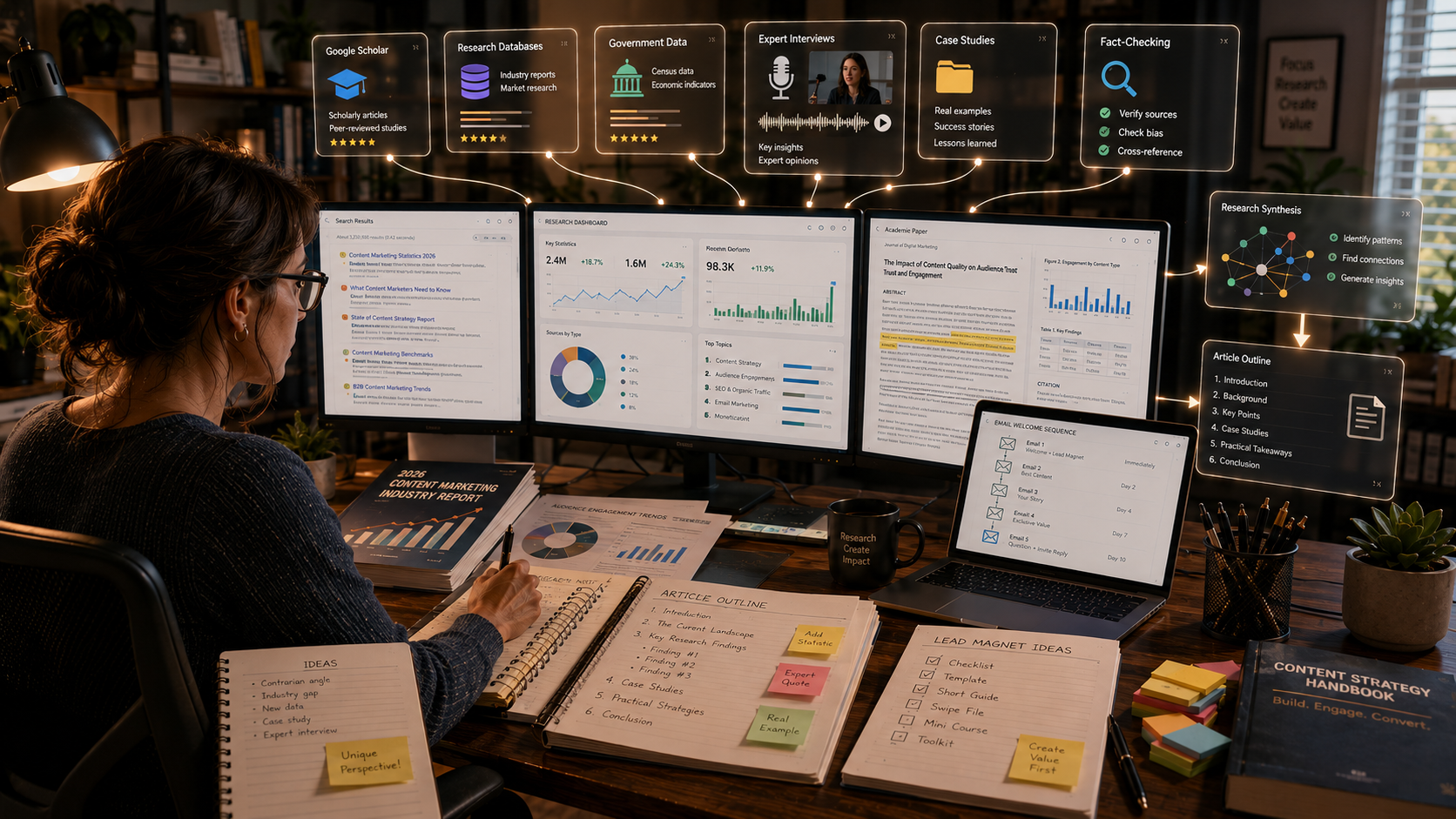
The difference between an average article and an authoritative one is rarely how long you spend researching. It is how effectively you research. With the right process, you can gather the facts, discover unique insights, and build a strong outline in just 30 minutes.
Many writers struggle with one of two problems.
They either begin writing with almost no research and produce shallow content...
...or they spend three hours reading articles, watching videos, and collecting information without ever writing a single paragraph.
Neither approach works.
Great content comes from focused research.
The goal is not knowing everything about a subject.
The goal is knowing enough to write the most helpful article your reader can find.
This framework helps you do exactly that in thirty minutes or less.
The 30-Minute Research Framework
The system is divided into five phases.
Each phase has a time limit.
Those limits are intentional.
Without them, research becomes procrastination disguised as productivity.
Phase 1: Define Your Angle (3 Minutes)
Before opening Google, answer three questions.
What specific question will this article answer?
Avoid broad topics.
Instead of:
Content Marketing
Write:
Why Do Most Content Marketing Strategies Fail?
Specific questions produce focused research.
Who Is Your Reader?
Think about your audience.
Are they:
-
Beginners?
-
Intermediate users?
-
Professionals?
Your research should match their experience level.
What Can You Add?
Search your topic.
Read the first few results.
Ask yourself:
-
What do they all cover?
-
What do they all miss?
-
How can I improve on them?
Finding your unique angle before researching saves enormous amounts of time later.
Phase 2: Gather Core Facts (10 Minutes)
Now begin collecting information.
You only need three categories.
Foundational Facts
These include:
-
Statistics
-
Definitions
-
Industry data
-
Historical information
Reliable sources include:
-
Google Scholar
-
Government databases
-
Pew Research
-
Statista
-
Industry reports
-
Official publications
Expert Opinions
Readers trust experienced voices.
Look for:
-
Interviews
-
Conference presentations
-
Podcasts
-
Books
-
LinkedIn articles
-
Industry blogs
Collect useful quotations and practical insights.
Real Examples
Readers remember stories more than statistics.
Search for:
-
Case studies
-
Success stories
-
Failures
-
Reddit discussions
-
Industry forums
-
Practitioner interviews
Real examples transform abstract advice into practical learning.
Phase 3: Find the Unique Angle (5 Minutes)
Now review everything you've gathered.
Look for opportunities.
Contradictions
Do respected experts disagree?
Conflict creates interesting articles.
Gaps
What important question is nobody answering?
Filling that gap immediately makes your article more valuable.
Connections
Can ideas from another industry improve this topic?
Cross-disciplinary thinking often creates the most original content.
Updates
Has new technology changed the landscape?
Older articles may already be outdated.
Publishing current information gives readers a reason to choose your work.
Contrarian Ideas
Sometimes conventional wisdom is incomplete.
If you have evidence supporting another perspective, use it.
Just make sure your argument is supported by credible sources.
Write your central idea as one sentence.
Everything else in your article should support that statement.
Phase 4: Build Your Outline (5 Minutes)
Research without organization quickly becomes overwhelming.
Create a simple structure.
Introduction
What problem are you solving?
Why should the reader continue?
Background
Explain the essential context.
Keep it brief.
Main Sections
Create three to five primary sections.
Support each with:
-
Statistics
-
Examples
-
Quotes
-
Case studies
Practical Takeaways
Answer:
"What should the reader do next?"
Practical advice increases article value.
Conclusion
Summarize the central lesson.
Reinforce your thesis.
Give readers one memorable takeaway.
Phase 5: Fill the Gaps (7 Minutes)
Now review your outline.
Ask yourself:
Where is my evidence weakest?
Search only for the missing pieces.
Perhaps you need:
-
One statistic
-
One example
-
One quote
-
One counterargument
Targeted searching is dramatically faster than general browsing.
Research Tools That Save Time
Several tools consistently improve research speed.
Google Search Operators
Examples include:
site:reddit.com SEO
Find real user experiences.
filetype:pdf content marketing report
Locate downloadable research.
site:edu email marketing
Find educational resources.
after:2025
Limit results to recent information.
AI Research Assistants
Artificial intelligence can:
-
Summarize reports
-
Extract key points
-
Compare sources
-
Identify themes
Always verify important facts using primary sources.
AI accelerates research.
It should never replace fact-checking.
Save Your Sources
Use tools such as:
-
Notion Web Clipper
-
Raindrop.io
-
Browser bookmarks
-
Obsidian
Capture sources while researching.
Never assume you'll find them again later.
RSS Readers
Follow trusted industry publications.
Over time, your RSS reader becomes a constantly growing research library.
Citation Managers
If you regularly produce research-heavy content, consider:
-
Zotero
-
Mendeley
These organize references automatically.
Evaluating Your Sources
Not every source deserves equal trust.
Prefer Primary Sources
Whenever possible, cite:
-
Original studies
-
Government reports
-
Official announcements
-
Firsthand interviews
Avoid citing articles that merely summarize someone else's work.
Check Publication Dates
Old information becomes unreliable surprisingly quickly.
This is especially true for:
-
Technology
-
Marketing
-
Artificial Intelligence
-
SEO
-
Social media
Fresh information wins.
Understand Motivation
Consider who benefits.
A software company promoting research about software deserves more scrutiny than an independent university study.
Review Methodology
Statistics require context.
A survey of fifty people carries far less weight than one involving several thousand participants.
Understand how conclusions were reached.
Cross-Reference Important Claims
Never rely on a single source for surprising information.
Look for confirmation from multiple reputable organizations.
Build a Research Library
If you regularly write about the same subjects, stop researching from scratch every time.
Create reusable resources.
Topic Folders
Organize:
-
PDFs
-
Reports
-
Articles
-
Notes
-
Bookmarks
by subject.
Statistics Database
Maintain a document containing:
-
Verified statistics
-
Publication dates
-
Source links
Update it regularly.
Expert Quote Collection
Save insightful quotes from respected professionals.
A strong quotation can immediately strengthen future articles.
Archive Every Research Session
Every completed article leaves behind valuable notes.
Save them.
Your next article begins with an advantage.
The Biggest Research Mistake
Research feels productive.
Sometimes it isn't.
Without limits, research expands forever.
One more article.
One more video.
One more report.
Eventually, research becomes an excuse to delay writing.
The purpose of research is not complete knowledge.
It is sufficient knowledge to confidently help your reader.
When the timer reaches thirty minutes...
Stop researching.
Start writing.
The Bottom Line
Outstanding research is not about spending more time.
It is about spending your time intentionally.
Define your question.
Collect reliable evidence.
Find a unique angle.
Build your outline.
Fill the remaining gaps.
Repeat that process consistently, and you'll spend less time searching for information while producing articles that are more authoritative, more original, and far more valuable to your readers.