
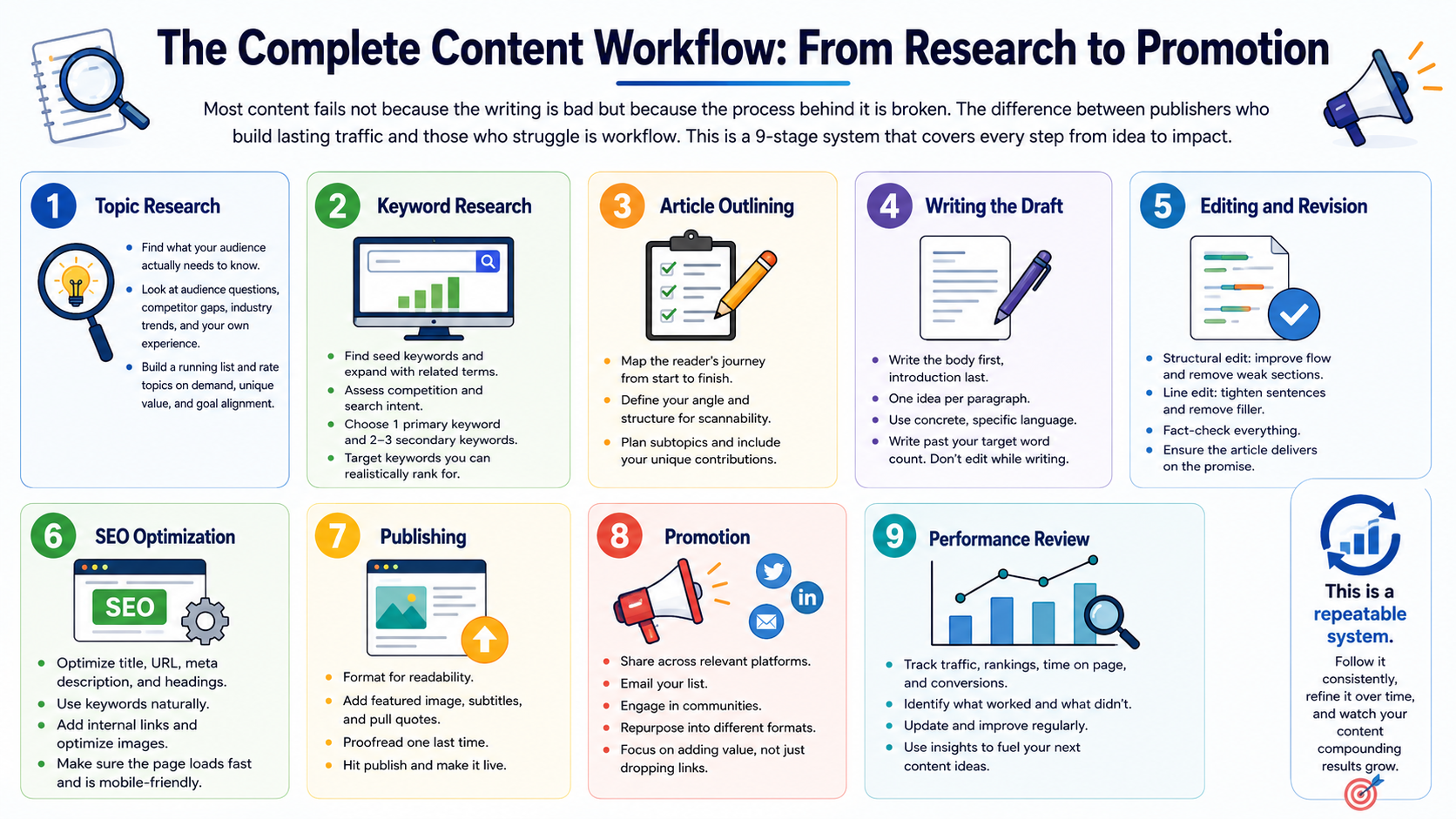
The Complete Content Workflow: From Research to Promotion
Most content fails not because the writing is bad but because the process behind it is broken. A great article with no keyword research gets no traffic. A well-optimized piece with no promotion stays invisible. A viral post with no follow-up strategy wastes its momentum.
The difference between publishers who build lasting traffic and those who struggle is rarely talent. It is workflow. The ones who win have a repeatable system that covers every stage from the initial idea to the final promotion push and performance review.
This is that system, broken into nine stages. Each one builds on the last. Skip any stage and the entire chain weakens.
Stage 1: Topic Research
Every piece of content starts with a question: what does my audience actually need to know?
The answer rarely comes from brainstorming in isolation. It comes from observation.
Customer and reader questions. What do people ask in your comments, emails, DMs, and support tickets? These are article topics disguised as conversations.
Competitor content gaps. Read the top-ranking articles for your niche. What do they all miss? What questions do their comment sections ask? Those gaps are opportunities.
Industry trends. Follow newsletters, podcasts, and trade publications in your space. When a new tool, regulation, or shift appears, the first publishers to cover it thoroughly capture the search traffic as interest grows.
Personal experience. What have you done, built, tested, or failed at that others in your audience have not? First-person operational knowledge is the most defensible content angle available.
Document every viable topic in a running list. Rate each one on three criteria: audience demand, your ability to provide unique value, and alignment with your publishing goals.
Stage 2: Keyword Research
A topic becomes a content opportunity when you attach search data to it.
Start with seed keywords. Take your topic and identify the two to three phrases someone would type into Google to find information about it. These are your seed keywords.
Expand with related terms. Use Google's autocomplete, the "People Also Ask" section, and the related searches at the bottom of search results to find variations and long-tail phrases.
Assess competition. For each keyword, look at what currently ranks on page one. If the top results are all from major publications with high domain authority, that keyword will be extremely difficult for a newer site. Target keywords where you can realistically reach the first page within six months.
Choose a primary keyword and two to three secondary keywords. The primary keyword goes in your title, URL, and first paragraph. Secondary keywords appear naturally in subheadings and body text.
Check search intent. Not all searches want articles. If the top results for your keyword are product pages, videos, or tools, a written article may not match what searchers expect. Choose keywords where informational content dominates the results.
Stage 3: Article Outlining
An outline prevents the two most common content problems: articles that ramble without structure and articles that miss critical subtopics.
Start with the reader's journey. What does the reader know when they arrive? What should they know when they leave? The outline maps the path between those two points.
Define your angle. Every article needs a perspective. "How to start a newsletter" is a topic. "How to start a newsletter that people actually open" is an angle. The angle determines which information to include and which to leave out.
Structure for scannability. Most online readers scan before they read. Use clear subheadings that tell the reader exactly what each section covers. Each section should deliver on the promise of its heading.
Include your unique contributions. Mark the specific places where you will add personal data, examples, or experience. These are the anchors that differentiate your article from every other piece on the same topic.
Stage 4: Writing the Draft
With research complete and an outline in place, the draft should move quickly.
Write the body first. Skip the introduction. Start with the section you know best. The introduction is easier to write once you know exactly what the article contains.
One idea per paragraph. Each paragraph should make a single point. If a paragraph covers two ideas, split it. Short paragraphs improve readability on screens.
Use concrete language. Replace abstractions with specifics. Instead of "optimize your workflow," say "batch all your image editing into Tuesday mornings so your writing days stay uninterrupted."
Write past your target word count. A 1,500-word target article should start as a 2,000-word draft. Editing will remove the weakest material, leaving only the strongest content.
Do not edit while writing. The draft phase and the editing phase use different mental processes. Switching between them slows both down. Get the complete draft on the page before making any corrections.
Stage 5: Editing and Revision
Editing is where good content becomes great content.
Structural edit. Read the complete draft and evaluate the overall flow. Does each section follow logically from the previous one? Does the article deliver on the promise made in the introduction? Move, merge, or delete sections as needed.
Line edit. Go sentence by sentence. Tighten wordy constructions. Replace passive voice with active voice. Remove filler words like "very," "really," "just," and "actually" unless they serve a purpose.
Fact check. Verify every statistic, name, date, and claim. Check that linked resources are current and functional.
Voice check. Read the article out loud. Flag any sentence that sounds unnatural or overly formal. Rewrite it in conversational language.
Fresh eyes. If possible, step away from the article for at least a few hours before the final review. Distance reveals problems that immersion hides.
Stage 6: SEO Optimization
SEO optimization happens after the writing is complete, not during it. Writing for humans first and optimizing for search engines second produces better results in both categories.
Title tag. Include your primary keyword near the beginning of the title. Keep it under 60 characters so it displays fully in search results.
Meta description. Write a compelling 150 to 160 character summary that includes the primary keyword and gives readers a reason to click.
URL structure. Use a short, descriptive URL that includes the primary keyword. Avoid dates, numbers, or unnecessary words in the URL.
Header tags. Use H2 tags for major sections and H3 tags for subsections. Include secondary keywords naturally in headings where they fit.
Internal links. Link to two to five other articles on your site that provide additional depth on topics mentioned in the current article. Internal linking builds topical authority and keeps readers on your site longer.
Image optimization. Every image should have descriptive alt text that includes relevant keywords where natural. Compress images to reduce page load time.
First paragraph keyword placement. Include your primary keyword within the first 100 words of the article naturally.
Stage 7: Publishing Checklist
Before hitting publish, verify these items:
- Title tag and meta description are set
- URL is clean and keyword-rich
- Hero image is uploaded with alt text
- All internal and external links work
- Categories and tags are assigned
- Author name and bio are attached
- Social sharing images are configured
- Mobile formatting looks correct
- Reading time estimate is accurate
- Call to action is present (newsletter signup, related article, or next step)
Stage 8: Distribution and Promotion
Publishing is the halfway point, not the finish line.
Email newsletter. Feature the article in your next newsletter with a compelling excerpt and direct link. Your email subscribers are your most engaged audience.
Social media. Share the article across your active platforms. Create platform-specific versions: a thread for X, a carousel summary for LinkedIn, a discussion prompt for Facebook.
Content repurposing. Extract quotes, statistics, and key takeaways from the article and turn them into standalone social posts throughout the following week.
Community sharing. Post the article in relevant online communities, forums, or groups where the topic is actively discussed. Add genuine context about why the community would find it valuable.
Cross-linking. Update older articles on your site to link to the new piece where relevant. This distributes authority and helps the new article get indexed faster.
Stage 9: Performance Tracking
Content strategy without measurement is guessing.
Track these metrics weekly for the first month:
- Organic search impressions and clicks (Google Search Console)
- Page views and time on page (analytics)
- Bounce rate
- Newsletter signups from the article
- Social shares and engagement
- Backlinks acquired
Monthly assessment. After 30 days, evaluate whether the article is trending toward your traffic goals. Articles that show early traction in search impressions but low clicks may need title or meta description improvements. Articles with high traffic but low engagement may need better content or calls to action.
Quarterly updates. Review top-performing articles every quarter. Update statistics, add new examples, and refresh any outdated information. Google favors recently updated content, and regular maintenance keeps your best articles competitive.
Putting It All Together
This workflow is not about doing more work. It is about doing the right work in the right order. A 1,500-word article that goes through all nine stages will outperform a 5,000-word article that skips research, optimization, and promotion every time.
The publishers who build sustainable traffic are not the fastest writers or the most prolific. They are the most disciplined about process. Build the workflow once, follow it consistently, and let the compounding effect of quality content do the heavy lifting over time.
