
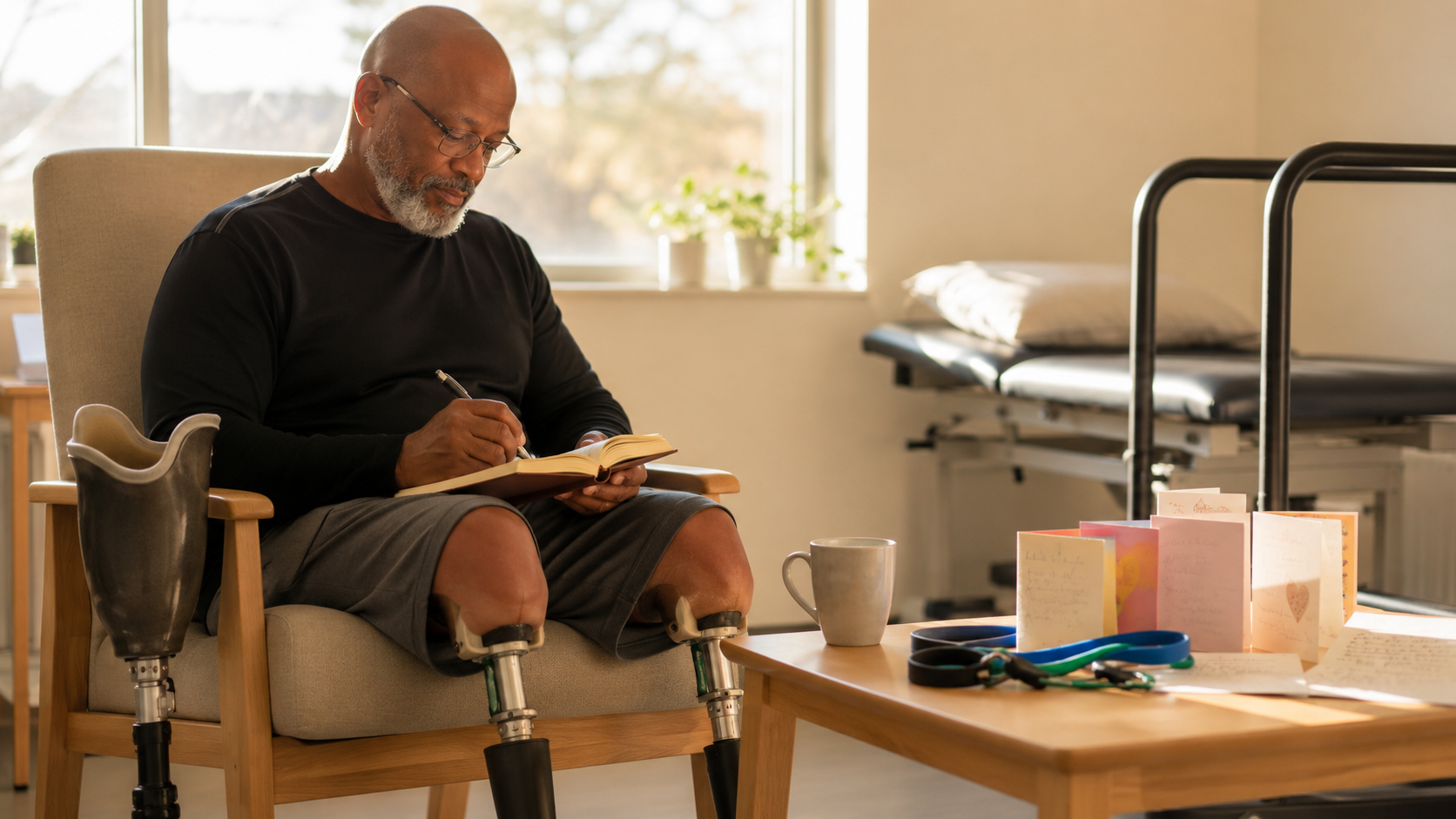
The first days after an amputation rarely feel like the beginning of a journey.
They often feel like survival.
There are doctor's appointments to remember, medications to take, wounds to care for, physical therapy sessions to attend, insurance paperwork to complete, prosthetic appointments to schedule, and emotions that seem to change by the hour. Family members try their best to help, but many are learning alongside you. Friends often don't know what to say. Even the simplest daily tasks suddenly require thought and planning.
Then someone says it.
"Just take it one day at a time."
It sounds like a comforting cliché.
Until you realize it may be the most practical advice you'll ever receive.
For someone recovering from limb loss, tomorrow can feel too far away. Next month can seem impossible to imagine. Even next week may bring more uncertainty than confidence.
But today?
Today can be managed.
Today can be survived.
Today can become one small victory.
That philosophy is exactly why I created the 365 Days of Strength: A First Year Recovery Journal for Amputees . It wasn't designed as another notebook that eventually ends up on a shelf. It was designed to become a quiet companion through one of life's most difficult transitions; one day, one entry, one victory at a time.
Recovery Isn't Measured in Giant Leaps
Movies love dramatic recoveries.
The patient struggles.
A montage begins.
Then suddenly they're walking confidently into the sunset.
Real recovery doesn't work that way.
Recovery is painfully ordinary.
It's sitting on the edge of the bed convincing yourself to stand.
It's learning how to transfer into a wheelchair without falling.
It's figuring out how to shower safely again.
It's putting on a shrinker sock for the first time.
It's managing phantom pain at three in the morning.
It's celebrating standing for another thirty seconds longer than yesterday.
Those moments rarely make headlines.
But together they rebuild a life.
The problem is that when you're living through recovery, those tiny victories are easy to overlook.
Instead, your attention naturally drifts toward everything you still cannot do.
"I still can't walk."
"I still can't drive."
"I still need help."
"I still hurt."
When that's your focus, progress becomes invisible.
A journal changes that.
Instead of measuring recovery by the finish line, it teaches you to measure recovery by today's progress.
That shift changes everything.
Big Goals Can Feel Impossible
Most amputees have enormous goals.
Walking independently.
Returning to work.
Playing with grandchildren.
Driving again.
Going fishing.
Traveling.
Getting back into the garden.
Running.
Hiking.
Returning to the life they loved.
Those dreams matter.
They give recovery direction.
But during the early weeks, they can also become overwhelming.
Imagine standing at the bottom of a mountain while barely able to stand on your own two feet.
Looking at the summit, every day can become discouraging.
Instead, recovery becomes far more manageable when the only assignment is today's step.
Can I finish today's therapy?
Can I learn one new transfer?
Can I reduce my pain slightly?
Can I practice balance for five more minutes?
Can I ask one question at my prosthetic appointment?
Can I smile once today?
Those are achievable goals.
And achievable goals build confidence.
Confidence builds momentum.
Momentum builds recovery.
One Small Entry Can Change Your Perspective
Many people hear the word "journal" and immediately imagine pages of writing.
That image alone can discourage someone who's exhausted, hurting, or emotionally drained.
Recovery doesn't leave much energy for writing essays.
That's why a recovery journal should never feel like homework.
Sometimes half a page is enough.
Sometimes only a few sentences.
Sometimes a checklist.
Sometimes only one word.
Questions like these require very little energy but reveal an incredible amount over time:
What worked today?
Maybe you found a comfortable pillow position.
Maybe your prosthetic socket fit better.
Maybe physical therapy hurt less.
Maybe you laughed for the first time all week.
Small successes deserve to be remembered.
What hurt today?
Pain changes.
Swelling changes.
Skin irritation changes.
Emotions change.
Recording them creates valuable information for both you and your medical team.
What gave me hope today?
A nurse's encouragement.
A visit from family.
A successful therapy session.
Seeing another amputee walking confidently.
A phone call.
A sunrise.
Hope often arrives quietly.
Writing it down helps you recognize it.
What do I want to remember?
Recovery is full of lessons.
Some practical.
Some emotional.
Some deeply personal.
Capturing those lessons creates a roadmap you'll appreciate later.
Why Short Entries Work Better
There are days when recovery is exhausting.
Pain medication causes fatigue.
Therapy drains every ounce of energy.
Sleep is interrupted.
Emotions swing unexpectedly.
On those days, asking someone to write three pages is unrealistic.
But asking them to complete half a page?
That's manageable.
A recovery journal should remove pressure, not create it.
A simple format encourages consistency.
Consistency matters far more than length.
Writing a little every day creates a far more complete picture than writing several pages once every few weeks.
Recovery isn't made of dramatic moments.
It's built from ordinary days.
Those ordinary days deserve to be recorded.
Tracking Progress You Can't See
One of the cruelest parts of recovery is that improvement often happens too slowly to notice.
Day to day, nothing seems different.
Week to week, it still feels frustrating.
Then one day someone asks:
"Remember when you couldn't even sit up by yourself?"
And suddenly you realize you've come much farther than you thought.
A journal makes those invisible improvements visible.
You can look back and read:
"I stood for thirty seconds today."
Then several weeks later:
"I walked ten feet."
Later:
"I walked around the house."
Months afterward:
"I drove myself to therapy."
Those entries become undeniable evidence.
You're improving.
Even when your mind tries to convince you otherwise.
Some people misunderstand gratitude.
They think it means pretending everything is wonderful.
It doesn't.
You can be grateful while still hurting.
You can be thankful while still grieving.
Both can exist together.
A simple gratitude section encourages people to notice the good without denying the difficulty.
Maybe today you're thankful for:
A caring therapist.
A spouse who never leaves your side.
Pain medicine that finally worked.
A prosthetist who listened.
A child who made you laugh.
A neighbor who brought dinner.
The ability to stand a little longer.
Those moments deserve attention.
They strengthen emotional resilience without minimizing real struggles.
Weekly Reflections Create Perspective
Recovery isn't only about individual days.
Weeks tell stories too.
Every seven days offers an opportunity to pause.
Ask yourself:
What improved?
What remained difficult?
What surprised me?
What am I proud of?
What do I want to focus on next week?
Those reflections prevent recovery from becoming an endless cycle of appointments and exercises.
They help people recognize patterns.
Maybe Mondays are emotionally difficult.
Maybe Thursdays always bring therapy breakthroughs.
Maybe mornings are easier than evenings.
Patterns become valuable information.
Monthly Milestones Matter
A month may not sound like much.
In amputation recovery, it's enormous.
Month One.
The wounds begin healing.
Month Two.
Strength slowly returns.
Month Three.
Perhaps the first prosthetic fitting.
Month Four.
Maybe independent walking begins.
Every recovery is different.
There is no universal timeline.
That's why monthly milestone pages are so valuable.
They don't compare you to someone else's progress.
They compare you only to yourself.
That is the only comparison that matters.
Letters to Your Future Self
Recovery changes people.
Sometimes dramatically.
Writing a letter to your future self creates something remarkable.
You might write:
"I'm scared today."
"I don't know if I'll ever walk again."
"I miss my old life."
"I hope you're doing better than I am today."
Months later, you'll read those words with completely different eyes.
You'll remember how far you've come.
You'll realize that the person writing those words kept going.
That realization builds confidence unlike anything else.
Encouragement from Loved Ones
Recovery doesn't belong only to the amputee.
It belongs to spouses.
Children.
Parents.
Friends.
Caregivers.
Grandchildren.
Nurses.
Therapists.
Everyone walks the journey differently.
That's why dedicated pages where loved ones can leave encouraging notes become priceless.
A spouse might write:
"I'm proud of how hard you're fighting."
A grandchild might draw a picture.
A therapist might recognize a breakthrough.
A prosthetist might celebrate a milestone.
Those pages become treasures.
On difficult days, they remind you that you're never recovering alone.
A Journal That Travels with You
Recovery doesn't happen in one location.
It happens everywhere.
Hospital rooms.
Rehabilitation centers.
Physical therapy clinics.
Prosthetic offices.
Your living room.
Your kitchen.
Your front porch.
A recovery journal becomes a companion through every stage.
Bring it to appointments.
Record questions.
Write answers.
Track socket adjustments.
Note skin issues.
Remember medication changes.
Keep therapy exercises.
Record victories before they're forgotten.
Years later, it becomes part medical history and part personal story.
A Resource for More Than One Person
Although the journal is written for amputees, its value extends much further.
Families better understand the emotional journey.
Caregivers recognize patterns.
Physical therapists see progress.
Occupational therapists understand challenges.
Prosthetists learn how fittings affect daily life.
Support groups find discussion topics.
Rehabilitation centers gain a structured recovery resource.
Prosthetic clinics can provide patients with something practical that extends care beyond the appointment.
Instead of simply sending someone home with instructions, they send them home with a companion.
That matters.
Recovery happens between appointments.
Why I Created This Journal
As a bilateral below-knee amputee myself, I know recovery isn't just physical.
It's emotional.
Mental.
Practical.
Spiritual.
Some days your biggest accomplishment isn't walking farther.
It's simply refusing to quit.
There were days when progress felt invisible.
Days when pain seemed louder than hope.
Days when frustration threatened to overshadow determination.
Looking back, I realize how valuable it would have been to have a place dedicated to recording those moments, not because every day was extraordinary, but because every day mattered.
That understanding became the foundation for 365 Days of Strength .
I wanted to create something I wish I had during my own first year.
Not another medical manual.
Not another motivational book filled with unrealistic optimism.
A practical, honest companion that acknowledges the difficult days while helping readers recognize the victories that might otherwise go unnoticed.
Because recovery isn't built on perfection.
It's built on persistence.
Every Entry Becomes Proof
Months from now, you'll flip back through the pages.
You'll read about difficult mornings you barely remember.
You'll smile at milestones that once seemed impossible.
You'll see your handwriting become steadier.
Your thoughts become stronger.
Your confidence becomes clearer.
You'll discover something remarkable.
The person who wrote those first entries didn't know how the story would end.
They simply kept showing up.
One appointment.
One therapy session.
One difficult morning.
One hopeful afternoon.
One journal entry.
One victory.
Every page becomes proof that you kept going.
Every sentence becomes evidence that hope outlasted fear.
Every reflection becomes another step away from the worst day of your life and toward a future you may not yet be able to imagine.
Recovery isn't written in giant chapters.
It's written one day at a time.
One entry at a time.
One victory at a time.
And one day, when you need the reminder most, you'll look back through those pages and realize something extraordinary:
You were stronger than you ever believed.